Tutankhamun Etched in Firelight
Tutankhamun Etched in Firelight
Coming to auction
This work will be included in a Catawiki auction within the next 10 days. Join the collectors list below to follow our auctions.
Occasional e-mails only. Unsubscribe anytime. Privacy policy.
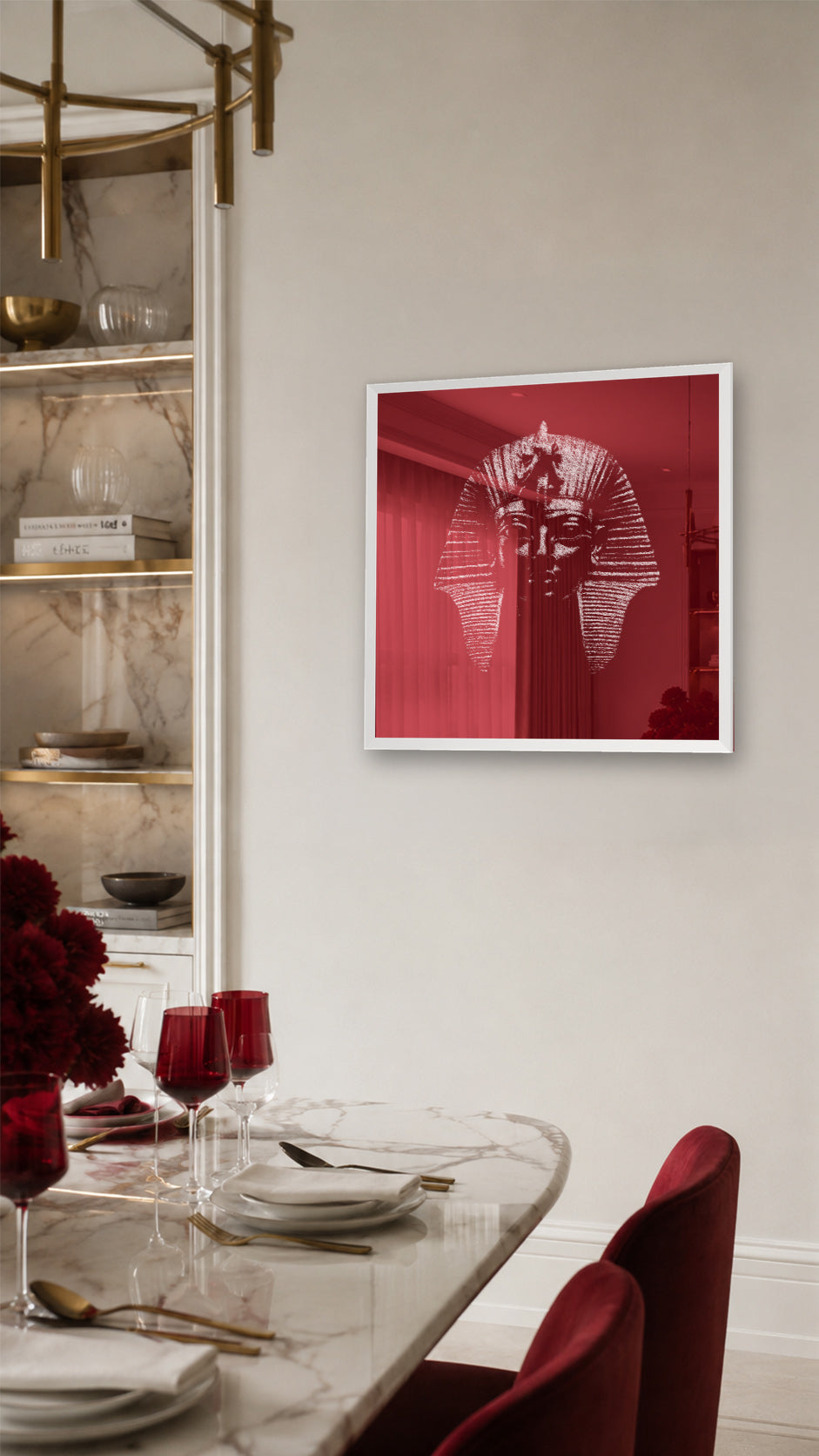
Tutankhamun Etched in Firelight begins with the headdress, and lets everything else stay hidden. The striped nemes rises across the surface as a field of fine scratches, each stripe catching the light like the ribs of gold under a museum lamp, while the cobra and the vulture keep their watch above the brow exactly where three thousand years of ritual placed them.
The face is the work's quiet decision. Where a painter would have added shadow and skin, here nothing is added at all: the cheeks, the mouth, the weight of expression are left as an untouched black oval, a silence at the centre of so much detail. The most famous face in ancient art is withheld from us, and that refusal becomes the real subject of the piece.
Red carries the meaning here. It is the colour of the sun disc Ra rode through the underworld each night, the colour of blood and of the desert that swallowed a boy king's tomb for three thousand years before it gave him back. Scratched into deep red coloured mirror glass, the mask seems to burn rather than shine, as though it were still lit by the torches that once found it in the dark.
No paint, no print, no pigment sits on this surface. The image exists only where the material has been taken away, a field of individual marks that a screen printer's flat black and gold could never hold. Monumental from across a room, it resolves up close into nothing but controlled surface damage and reflected light, structure built by subtraction.
The mirror never lets you stand outside the work. The gallery around it, its walls, its track lights, and your own outline settle into the red surface between the scratches, so that looking at Tutankhamun means finding yourself looking back from inside his headdress. Light does not create this image. It sharpens it, deepening the contrast without ever making the mask appear or vanish, so the pharaoh keeps his hold on the room whether the lights are raised or low.
This piece continues the Art on Mirror series by Tijs Dragtsma, in which scratched imagery is set into coloured mirror glass and the viewer becomes part of the work. A visual language where damage is not destruction, but structure, and where the mirror turns looking into taking part.
"Even a god king keeps one face he will not show you."
More about the artist, process and materials can be found on the About page.
Questions about this work, availability or shipping can be sent through the contact page.