The Invader Holds the Green
The Invader Holds the Green
Coming to auction
This work will be included in a Catawiki auction within the next 10 days. Join the collectors list below to follow our auctions.
Occasional e-mails only. Unsubscribe anytime. Privacy policy.
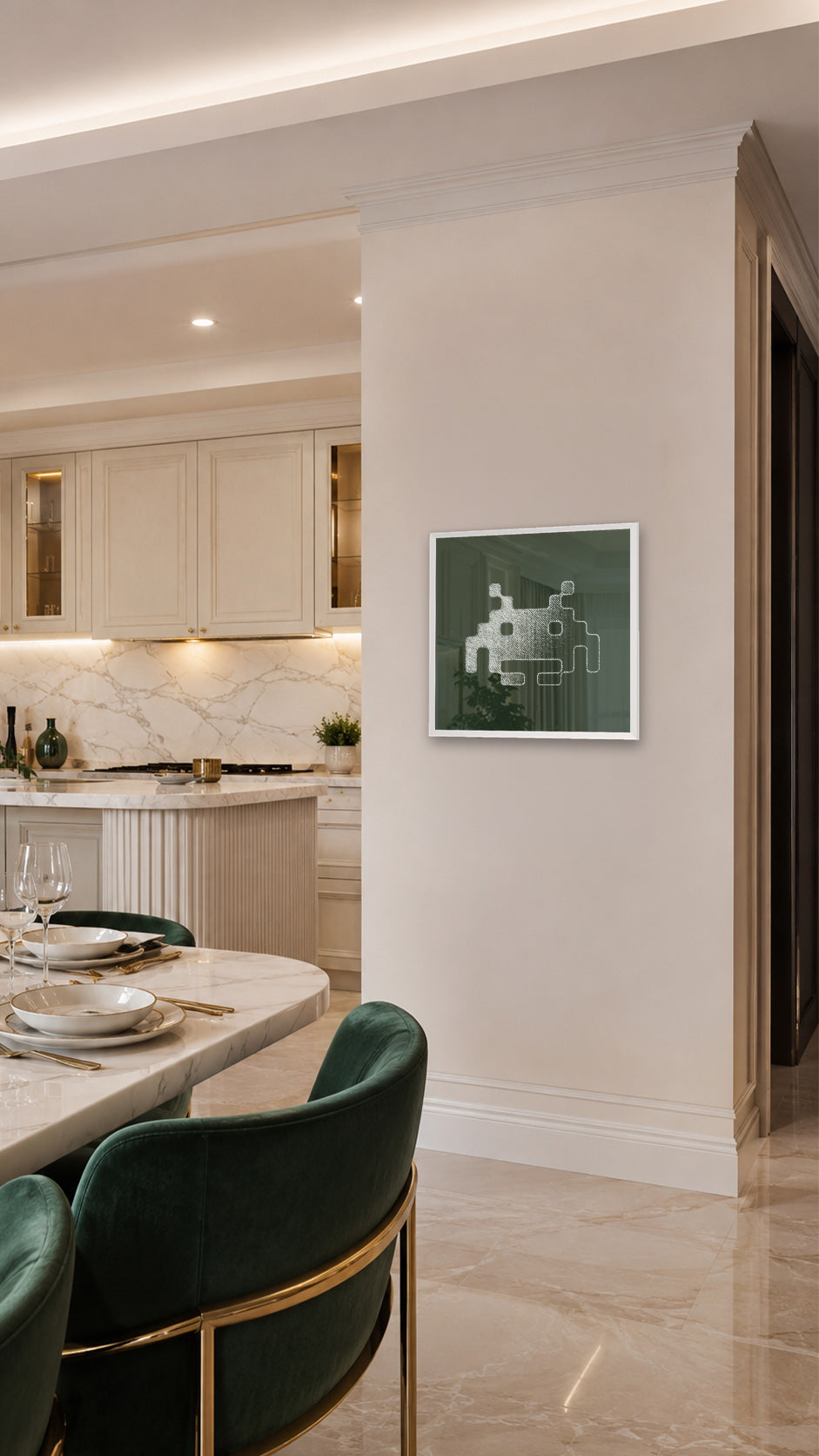
The Invader Holds the Green brings one of gaming's oldest ghosts back from the screen and into the room. The familiar silhouette, built from coarse, blocky pixels, two antennae raised like a question, is instantly recognisable, yet here it is slowed down, scaled up, and given a weight it never had on a cathode tube. What was once a flat, repeatable enemy becomes a singular presence, studied rather than shot at.
The image is not added to the glass, it is taken from it. A field of individual marks and a field of fine scratches, held by thick contour lines and coarse halftone dots, pull the invader's lit side out of the dark, while its other half stays unlit, folded back into the void. From across the room the creature reads as one monumental, glowing form. Step closer and that form dissolves into the raw texture of the surface itself, controlled surface damage standing in for ink that was never used.
Green carries this particular invader. It is the colour of old phosphor screens and night vision, of arcade light in a dark room, of something slightly alien and slightly familiar at once. Set into deep green coloured mirror glass, the creature seems to glow from inside its own atmosphere, caught between nostalgia and quiet menace.
Because the work is mirrored, the gallery around it becomes part of the piece. Walls, light fixtures and the viewer's own reflection settle into the dark half of the invader, so that looking at the work means standing inside it. Light does not create this image, it is always there, scratched permanently into the surface. What light does is sharpen it: under a direct source the contrast deepens and the marks catch and flare, and as the room's reflection shifts, the invader itself never moves and never fades.
Underneath the pop culture surface sits a quieter idea about repetition and memory, about how a shape designed to be destroyed over and over became, instead, something permanent. This work continues the Art on Mirror series by Tijs Dragtsma, in which scratched imagery is set into coloured mirror glass and the viewer becomes part of the work, a visual language where damage is not destruction, but structure, and where the mirror turns looking into taking part.
"Some ghosts do not fade. They are simply waiting for the light to find them again."
More about the artist, process and materials can be found on the About page.
Questions about this work, availability or shipping can be sent through the contact page.