Slow Pilgrims of Decay
Slow Pilgrims of Decay
Coming to auction
This work will be included in a Catawiki auction within the next 10 days. Join the collectors list below to follow our auctions.
Occasional e-mails only. Unsubscribe anytime. Privacy policy.
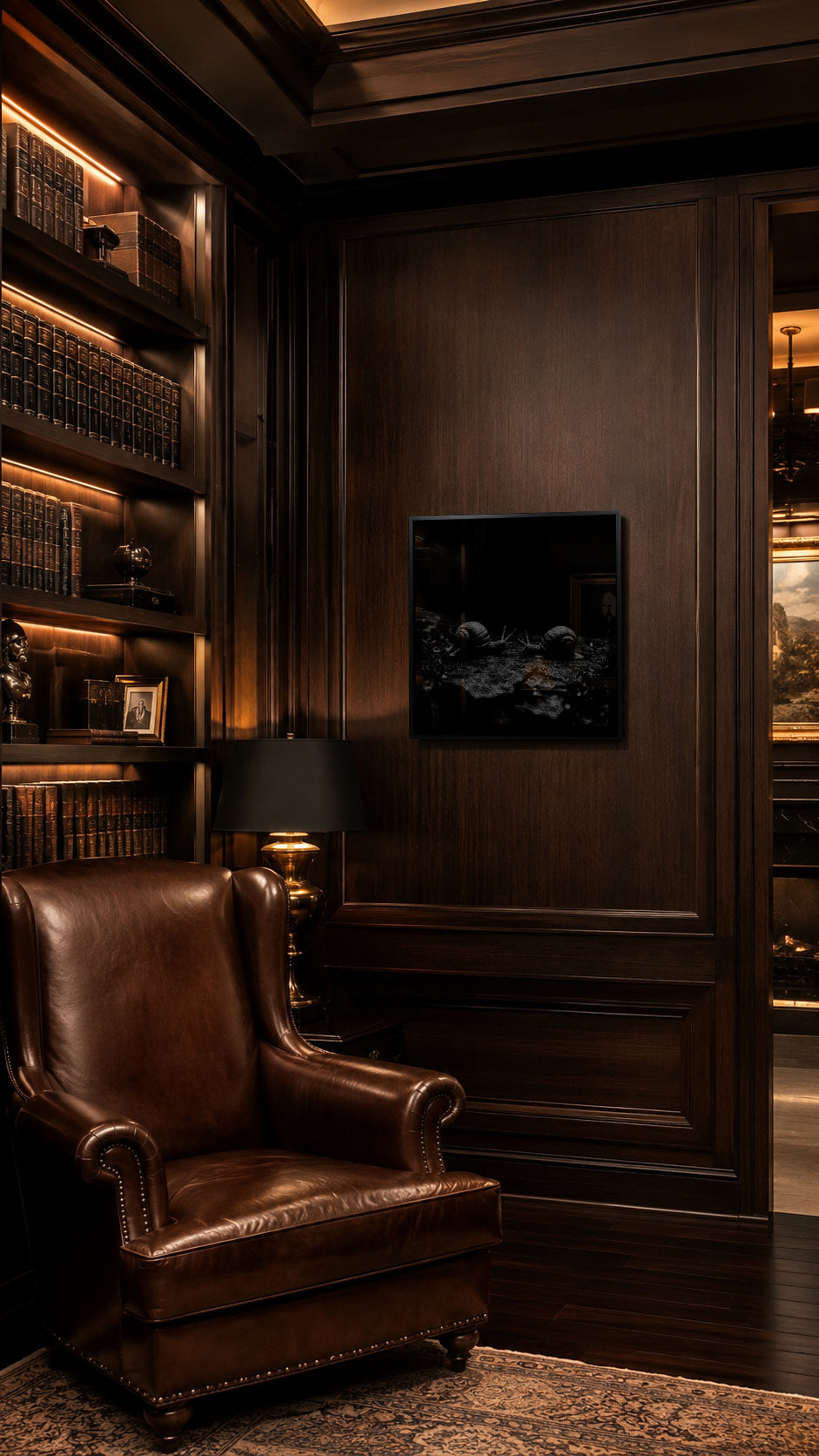
On wet stone, beneath a single hard light, two snails move across a bouquet already surrendering to its own weight. The anemones have wilted, their petals folding inward like exhausted hands, yet the snails continue, unhurried, indifferent to ruin. Slow Pilgrims of Decay holds this moment in deep black and white, a theatrical stillness where every fold of a dying petal and every ridge of a shell is rendered in absolute contrast.
No paint. No print. No ink. The image is scratched into the surface of the acrylic glass, built through controlled surface damage rather than pigment. It is not applied onto the surface, it emerges through removal, the way time itself works on a flower or a shell.
The snails are pilgrims in the oldest sense, creatures that carry their whole world on their backs and move through it without fear of arriving late. Around them, the anemones give themselves over to gravity and time, yet nothing here reads as tragedy. It is procession, patience, and the strange dignity of things that keep going after their bloom has passed.
The image is always present, visible in any light. Under direct light the scratches catch and reflect, and the contrast deepens, the wet stone gleams, the shells take on a quiet shine. It reads differently from different angles, without ever losing the image. Light does not create the image. It sharpens it.
From across a room, the work reads as a single theatrical scene, monumental in its darkness. Move closer and that scene dissolves into a field of controlled scratches, a quiet surface of marks that only resolve into snails and wilted flowers from a distance. Closeness reveals texture, distance reveals meaning.
Slow Pilgrims of Decay continues the Art with Scratch series by Tijs Dragtsma, in which imagery is constructed through controlled surface damage rather than pigment or print.
It is a study in what remains worth carrying after beauty fades, and what keeps moving even as everything around it gives way. A visual language where damage is not destruction, but structure.
"Even in decay, something keeps walking."
More about the artist, process and materials can be found on the About page.
Questions about this work, availability or shipping can be sent through the contact page.