R2-D2 in the Blue
R2-D2 in the Blue
Coming to auction
This work will be included in a Catawiki auction within the next 10 days. Join the collectors list below to follow our auctions.
Occasional e-mails only. Unsubscribe anytime. Privacy policy.
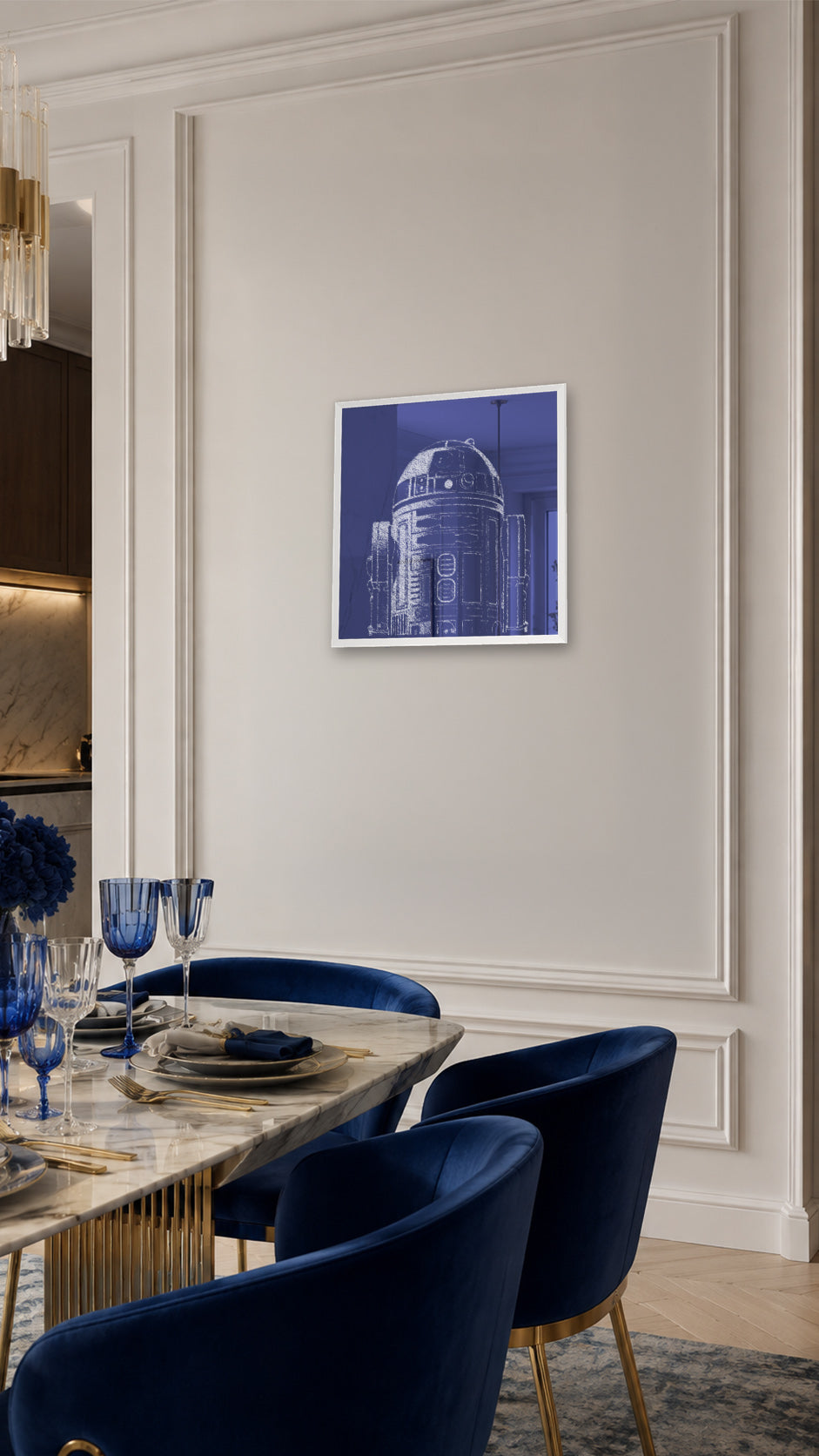
R2-D2 in the Blue brings one of cinema's most beloved droids into the Art on Mirror series, formed not by paint or print but by a field of individual marks scratched directly into deep blue coloured mirror glass. The familiar dome, the paneled body, the two steady legs, all of it emerges through removal rather than addition, as if the droid had always been waiting inside the surface and only needed the glass to be opened to find it.
The image lives in contrast. A field of fine scratches catches the light along one side of the droid, built from thick even contours and coarse white marks that read as texture up close and as a glowing figure from across the room. The rest stays in the deep blue, untouched and dark, so R2-D2 stands as a bright presence cut out of a void that never quite lets go of him.
Blue carries its own meaning here. It is the colour of signal lights and control panels, of the quiet loyalty this droid has shown across every story he has been part of, steady and dependable even in the dark. Set into coloured mirror glass, that blue becomes the field the droid must be found in, rather than simply the colour he is drawn in.
The mirror is never only a backdrop. Around and between the scratches, the room and the person standing in front of the work are reflected back into it, so the viewer becomes part of the composition, caught in the same blue that holds the droid. Light does not create this image. It sharpens it, deepening the contrast without ever making the droid appear or vanish, the reflection changes, the image stays.
R2-D2 in the Blue continues the Art on Mirror series by Tijs Dragtsma, in which scratched imagery is set into coloured mirror glass and the viewer becomes part of the work. This work is unique.
A visual language where damage is not destruction, but structure, and where the mirror turns looking into taking part.
"Some companions never need to speak to be understood."
More about the artist, process and materials can be found on the About page.
Questions about this work, availability or shipping can be sent through the contact page.