Light Finds Her Face
Light Finds Her Face
Coming to auction
This work will be included in a Catawiki auction within the next 10 days. Join the collectors list below to follow our auctions.
Occasional e-mails only. Unsubscribe anytime. Privacy policy.
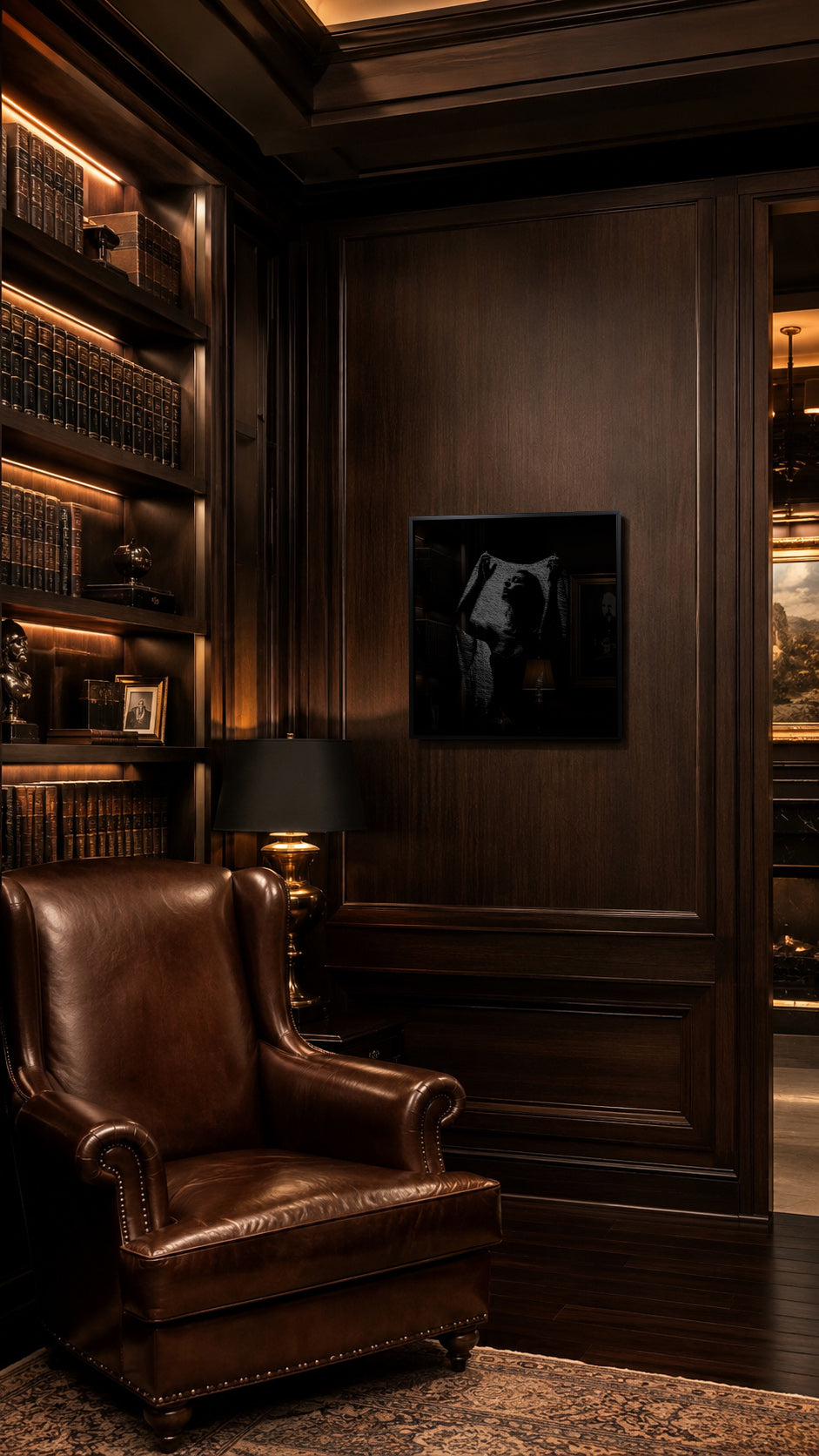
She lifts the veil, and for a moment the fabric holds the light before her face does. In Light Finds Her Face, a woman is caught between concealment and disclosure, her features emerging from a single hard light that falls from above into a background of pure, uninterrupted black. The cloth she raises is translucent, catching and scattering that light, so the moment reads as both an unveiling and a kind of surrender.
No paint. No print. No ink. The image is scratched into the surface of the acrylic glass, built through controlled scratches and controlled surface damage rather than anything added to it. What looks painterly, almost like an old master's canvas rendered in grain and shadow, is in fact the opposite of painting, a picture made by taking away.
The image is always present. It does not wait for light to exist. Under a directed source the scratches catch and reflect, the contrast deepens, and her face gains a dimension that flat photography cannot hold. Light does not create the image. It sharpens it. Move past it, and it reads differently again, without ever losing her.
From across a room, the work is monumental, a single figure suspended in black, the veil catching light like smoke. Step closer, and that same figure dissolves into a field of fine scratches, dust and grain rendered as texture, proof of a visual language where damage is not destruction, but structure.
The veil itself carries the weight of the piece. To lift it is to choose to be seen, and that choice, caught mid gesture, is where the drama lives. It is a study of the instant before recognition, when a person is still becoming visible to the room.
Light Finds Her Face continues the Art with Scratch series by Tijs Dragtsma, in which imagery is constructed through controlled surface damage rather than pigment or print. Each piece asks what remains once everything decorative is stripped away, and what is left, again and again, is presence.
"The face was always there. It only needed the light to find it."
More about the artist, process and materials can be found on the About page.
Questions about this work, availability or shipping can be sent through the contact page.