Hitchcock in Half Light
Hitchcock in Half Light
Coming to auction
This work will be included in a Catawiki auction within the next 10 days. Join the collectors list below to follow our auctions.
Occasional e-mails only. Unsubscribe anytime. Privacy policy.
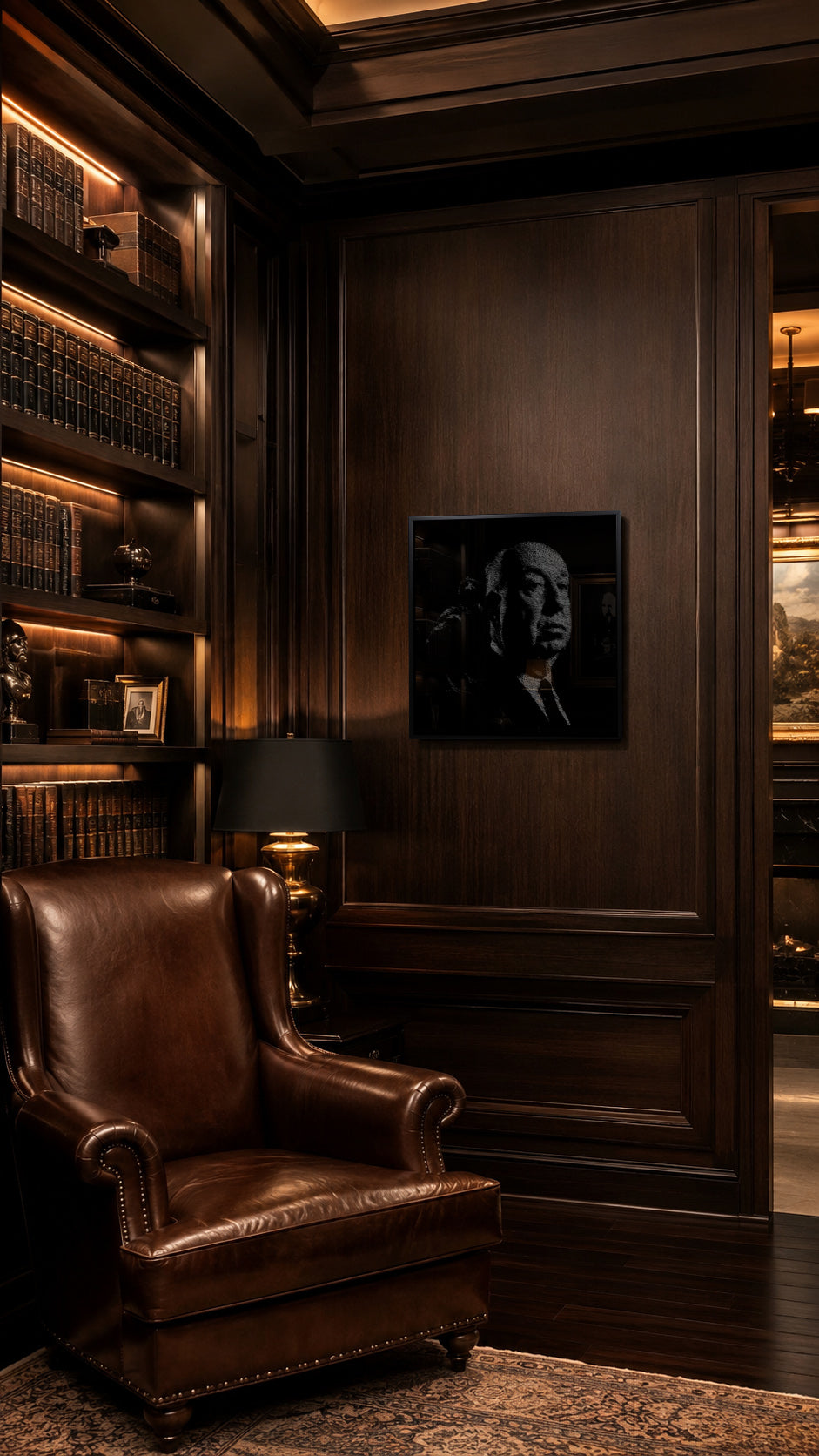
The face arrives first, and almost nothing else does. Out of a surface held almost entirely in black, Hitchcock's profile is built from a field of fine scratches, gathered densely across the brow, the broad nose, the famous jowl, so that the features seem to press forward out of the dark rather than sit upon it. The eye socket, the hollow beneath the jaw, the far side of the face stay untouched and vanish into pure black, so the man reads not as a photograph but as a presence caught mid turn, watching and being watched at once.
Behind him the crow is barely there. Its body is suggested by the faintest gathering of marks along a wing, a single claw gripping the shoulder, the rest left to the dark so that it feels less like a bird perched in the frame and more like something that has settled there without quite announcing itself. That restraint carries its own tension, the sense of a watcher just out of focus, which suits no subject better than this one.
No paint. No print. No ink. The image is scratched into the surface of the acrylic glass, a field of individual marks that catches and holds light rather than reflecting it back evenly, so the face seems lit from within even as the background refuses to give anything away.
The image is always present, visible in plain light as a quiet field of texture across the dark. Light does not create it. It sharpens it, so that under a direct source the ridges of the face catch and the contrast deepens, while from another angle the same face settles back into stillness without ever losing its form.
Hitchcock built a career on exactly this kind of looking, the audience watching a man who is always, in turn, watching something else, often something ominous perched just behind a shoulder. Here the formal language of the work becomes an extension of that idea: a portrait that must be looked for in the dark, built from damage rather than light, of a man who understood better than most how much is carried by what a frame chooses not to show.
This piece continues the Art with Scratch series by Tijs Dragtsma, in which imagery is constructed through controlled surface damage rather than pigment or print. A visual language where damage is not destruction, but structure.
"What isn't shown is still watching you."
More about the artist, process and materials can be found on the About page.
Questions about this work, availability or shipping can be sent through the contact page.