Formal Tenderness
Formal Tenderness
Coming to auction
This work will be included in a Catawiki auction within the next 10 days. Join the collectors list below to follow our auctions.
Occasional e-mails only. Unsubscribe anytime. Privacy policy.
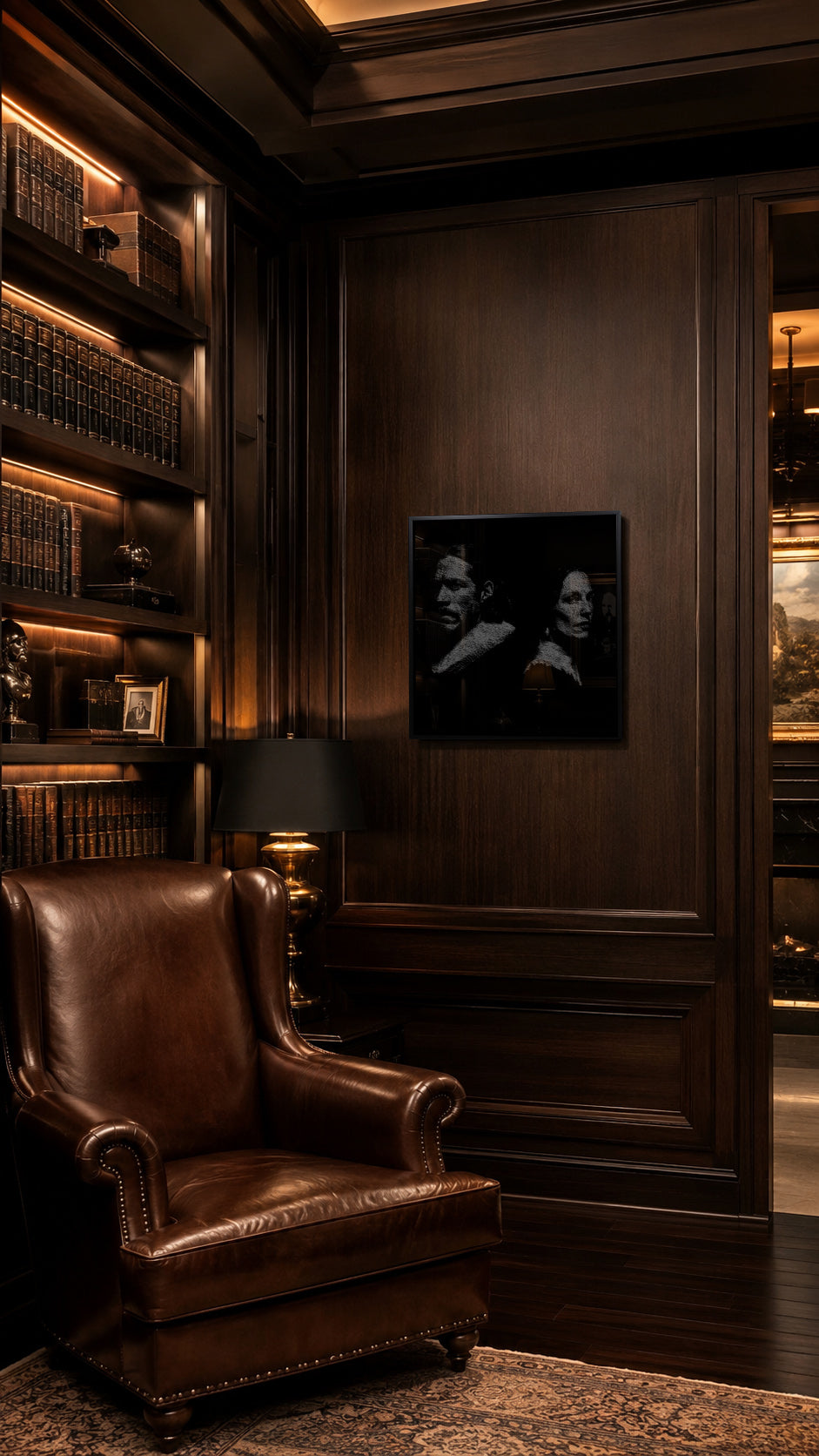
To compose yourself for a portrait is to decide what you are willing to make permanent. The posture is chosen. The garments are correct. The face is arranged into something between gravity and presence, nothing that would embarrass the household, nothing that reveals more than the occasion demands. And yet something persists inside all of that arrangement. Something the formal decision cannot quite close off, that settles into the space between two people standing close enough to share warmth in an absolute black where the only thing that exists is the light the painter has chosen to let fall.
They stand together, side by side, half-length, both figures fully contained within the frame. Wealthy. Composed. A directional light falls across their faces and garments with the deliberate precision of a Dutch master, shaping a jaw here, the edge of a collar there, leaving the surrounding depth entirely to the dark. Their expressions offer nothing beyond what the formal sitting has permitted. Their proximity to each other, in spite of all that restraint, offers everything.
Nothing was added to this surface. No paint, no ink, no print. The two figures exist because the acrylic glass was altered through controlled scratches that receive and release light differently depending on where the viewer stands and how the light arrives. They did not appear through addition. They emerged through removal. What is visible now is what the surface chose to yield when it was carefully taken away.
From across the room, the work carries the full gravity of a Golden Age double portrait. Two figures against a deep black ground, the composed authority of a prosperous household pressed into every posture and shadow. Step closer and the reading shifts. The image does not hold. What appeared as certainty dissolves into a field of marks on acrylic glass, a surface altered rather than painted, light and angle doing what no brush has ever done here. The portrait moves between clarity and quiet as the viewer moves, never entirely fixed, never entirely settled.
Formal Tenderness belongs to Dutch Glory, a series within Art with Scratch by Tijs Dragtsma in which imagery is constructed through controlled surface damage rather than pigment or print, and in which that same damage becomes a way of holding the human weight behind an era of prosperity, the private faces that wealth trained to show only what had been carefully chosen to be seen.
The title names the contradiction this work rests upon. Formality: what the sitting demands, what the portrait tradition was built to preserve, what wealth requires of the body and the face in the presence of the painter. Tenderness: what survives inside all of that, pressed quietly into the interval between two people who maintain the correct distance and hold something, nonetheless, that no commission ever asked to be recorded and no formal arrangement could prevent from being there.
A visual language where damage is not destruction, but structure.
"Restraint is not the opposite of tenderness. Sometimes it is the only form tenderness is permitted to take."
More about the artist, process and materials can be found on the About page.
Questions about this work, availability or shipping can be sent through the contact page.