A Waltz Pressed in Grooves
A Waltz Pressed in Grooves
Coming to auction
This work will be included in a Catawiki auction within the next 10 days. Join the collectors list below to follow our auctions.
Occasional e-mails only. Unsubscribe anytime. Privacy policy.
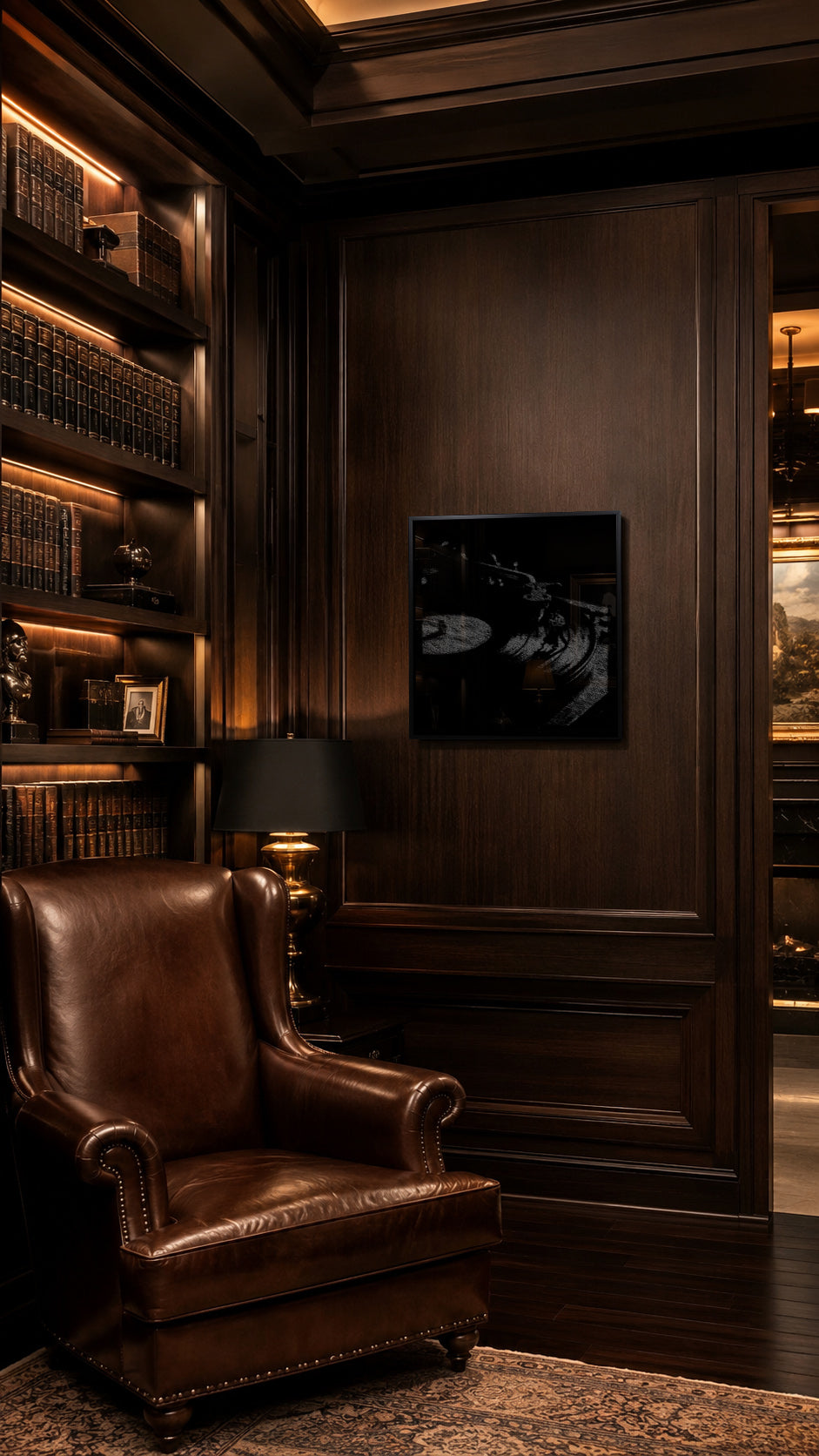
A record spins beneath the heavy arm of a turntable, and on its turning surface a couple holds each other mid step, caught forever inside the music that made them move. A Waltz Pressed in Grooves does not show us the dance so much as the trace it leaves, the way a song outlives the room it played in.
The tonearm and the needle arc across the frame as a field of fine scratches, bright where the light finds them, so that the mechanism itself seems to hum with motion even while perfectly still. Around it the grooves of the record curve outward in rings of controlled surface damage, a field of individual marks that catches the eye and pulls it inward, toward the small figures turning at its centre.
The dancers themselves stay dark, a quiet silhouette cut out of all that light. They do not shine, they withhold, and that withholding is what makes them feel alive among the glow around them, two people keeping something private inside a machine built for playing music to everyone else.
There is a tenderness in the scale here, a waltz made small enough to fit in the width of a single groove, as if intimacy always needs less room than we think, a turn, a held hand, a few bars of a song nobody else can hear the way the dancers do.
No paint. No print. No ink. The image is scratched into the surface of the acrylic glass, present at every hour, in every light. Direct light makes the grooves catch and shine, the contrast deepens, the waltz comes forward, and in softer light the same couple settles back into quiet, never gone, only resting. Light does not create the image. It sharpens it.
A Waltz Pressed in Grooves continues the Art with Scratch series by Tijs Dragtsma, in which imagery is constructed through controlled surface damage rather than pigment or print. A visual language where damage is not destruction, but structure.
"Some dances are too small to hear, and too lasting to stop."
More about the artist, process and materials can be found on the About page.
Questions about this work, availability or shipping can be sent through the contact page.