A Nymph Dissolved Into Dust
A Nymph Dissolved Into Dust
Coming to auction
This work will be included in a Catawiki auction within the next 10 days. Join the collectors list below to follow our auctions.
Occasional e-mails only. Unsubscribe anytime. Privacy policy.
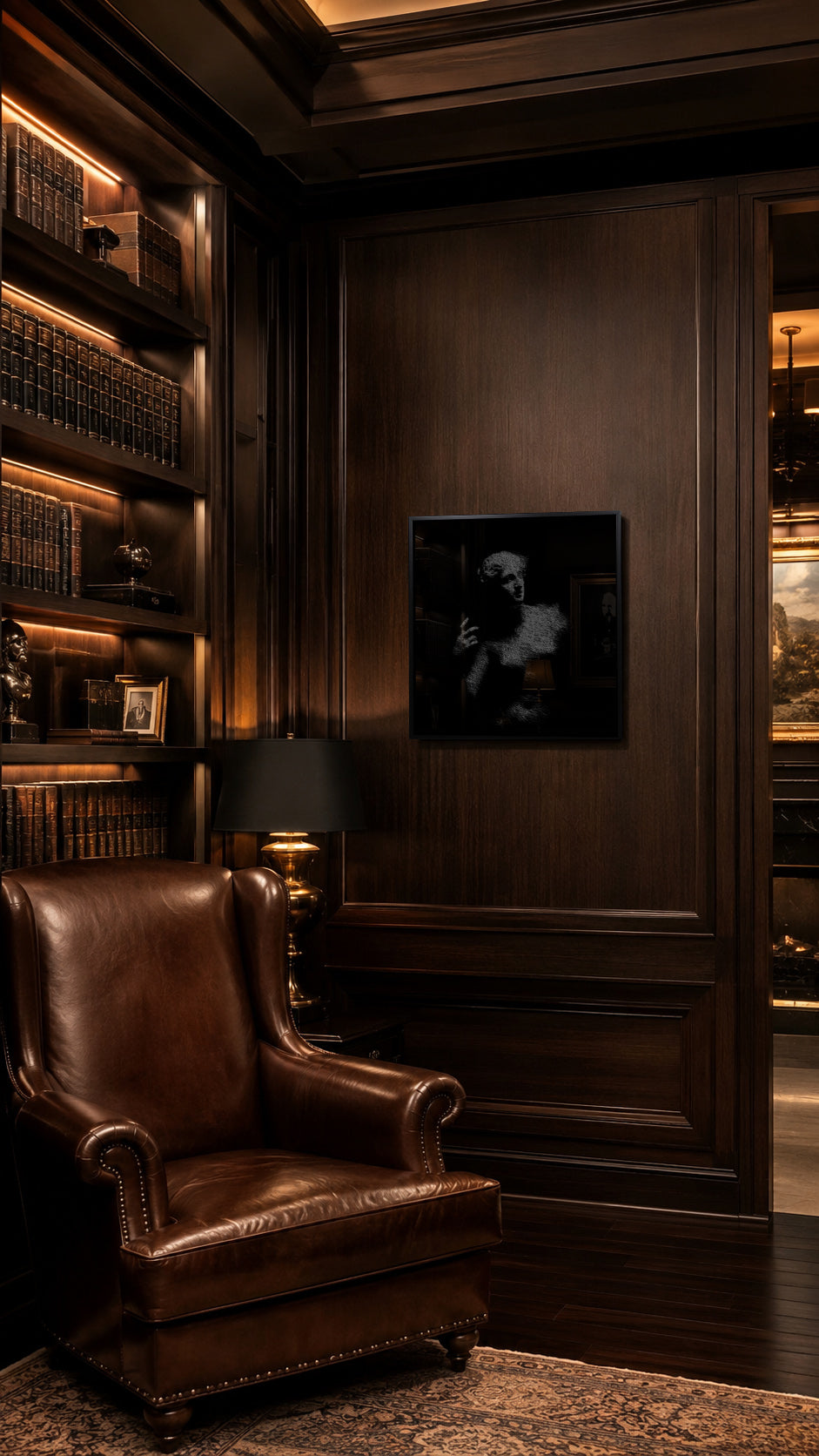
The first thing the eye finds is not her face but the cloud at her shoulder, a dense, restless field of fine scratches that catches more light than anything around it. It takes a moment to understand that this brightness is not decoration. It is the place where she is leaving.
Her face holds still inside all of that motion. Built from the same field of individual marks, worked fine enough to carry a brow, a parted mouth, the soft turn of a head looking slightly away, it reads as entirely present, composed, almost unconcerned with what is happening at her own shoulder. Nothing in her expression asks for help.
One hand stays raised beside her, fingers lightly curled, caught mid gesture rather than mid collapse. It is the most delicate scratch work in the piece, every knuckle and nail given its own density of marks, and it is also the last clearly human thing left before the body gives way to dust.
No paint. No print. No ink. The image is scratched into the surface of the acrylic glass, built through removal rather than addition. Where the shoulder dissolves, the marks crowd and scatter into an uneven, breathing brightness. Lower down, the torso is barely touched, left to sink back toward the black it came from, with only a single quiet fragment of scratching drifting apart from her, already its own small shape in the dark.
The image is always present, visible with or without direct light. Light does not create it. It sharpens it, deepening the pull between the face that still holds and the shoulder that no longer does, and the work reads differently from across a room than it does standing close, without ever losing her.
A Nymph Dissolved Into Dust belongs to The Unmaking, a series within Art with Scratch by Tijs Dragtsma in which imagery is constructed through controlled surface damage rather than pigment or print, and in which that same damage becomes a way of asking how much of a body, a beauty, a self can be given up before the gesture that defined it is finally let go as well.
A nymph was never carved to last, only to be looked at once, closely, before the light moved on.
"What remains is not the marble. It is the way she kept her hand raised while it left her."
More about the artist, process and materials can be found on the About page.
Questions about this work, availability or shipping can be sent through the contact page.