A Hundred Silhouettes Watching Back
A Hundred Silhouettes Watching Back
Coming to auction
This work will be included in a Catawiki auction within the next 10 days. Join the collectors list below to follow our auctions.
Occasional e-mails only. Unsubscribe anytime. Privacy policy.
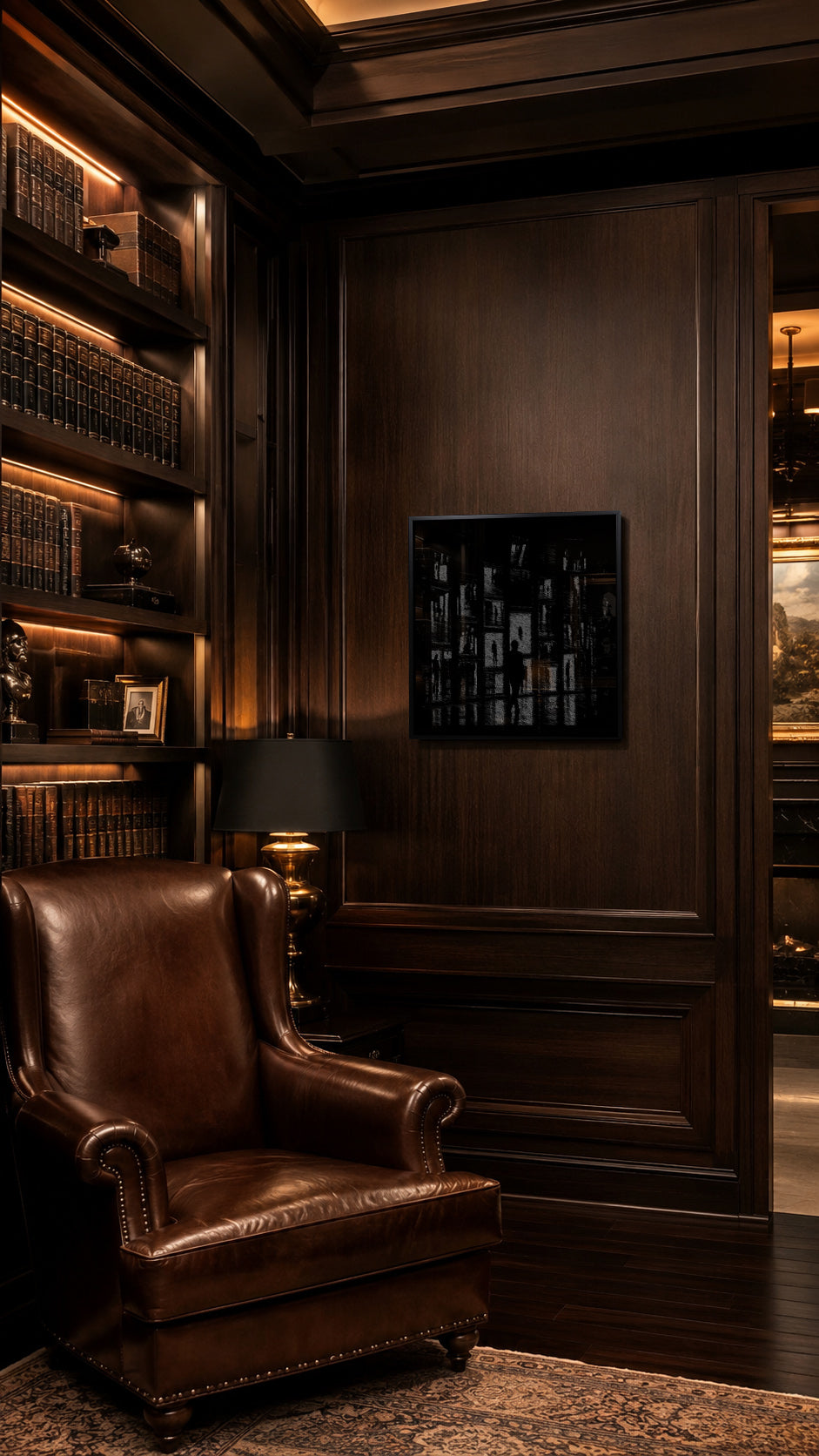
A single figure walks into a room built entirely of frames, and in nearly every one of them another version of him is already there, already turned, already watching him from the far side of the glass. He has not entered a gallery so much as an argument about who he actually is, restaged on every wall around him.
No paint. No print. No ink. The image exists because material has been taken away, not laid down, scratched into the surface of the acrylic glass rather than applied onto it. The room he walks through is built the same way he is, out of what has been removed.
The image is always present, in daylight or in shadow. Light does not create the image. It sharpens it. Under a raking light the scratched lines catch and hold, the contrast deepens, and the watching figures seem to step forward out of the surface. Move around it and the same room reads differently again, quieter, then sharper, without ever losing the man at its centre.
What the piece is really about is the strange arithmetic of being seen. One figure becomes many, and the many do not offer him company, they offer scrutiny. Every frame holds a version of himself looking back, and the effect feels less like a hall of mirrors than an interrogation built from portraits. To be surrounded by yourself, endlessly, is its own kind of isolation.
From across a room the piece reads as a single dark hallway, one man walking away from the viewer into architecture. Closer, that hallway dissolves into a field of controlled scratches, each frame its own quiet storm of marks that only resolves into a figure again at a certain distance. It asks to be seen twice, once as a whole and once as its surface.
A Hundred Silhouettes Watching Back continues the Art with Scratch series by Tijs Dragtsma, in which imagery is constructed through controlled surface damage rather than pigment or print. A visual language where damage is not destruction, but structure.
"He walked in alone. Every frame disagreed."
More about the artist, process and materials can be found on the About page.
Questions about this work, availability or shipping can be sent through the contact page.