A Handshake Over the Fallen
A Handshake Over the Fallen
Coming to auction
This work will be included in a Catawiki auction within the next 10 days. Join the collectors list below to follow our auctions.
Occasional e-mails only. Unsubscribe anytime. Privacy policy.
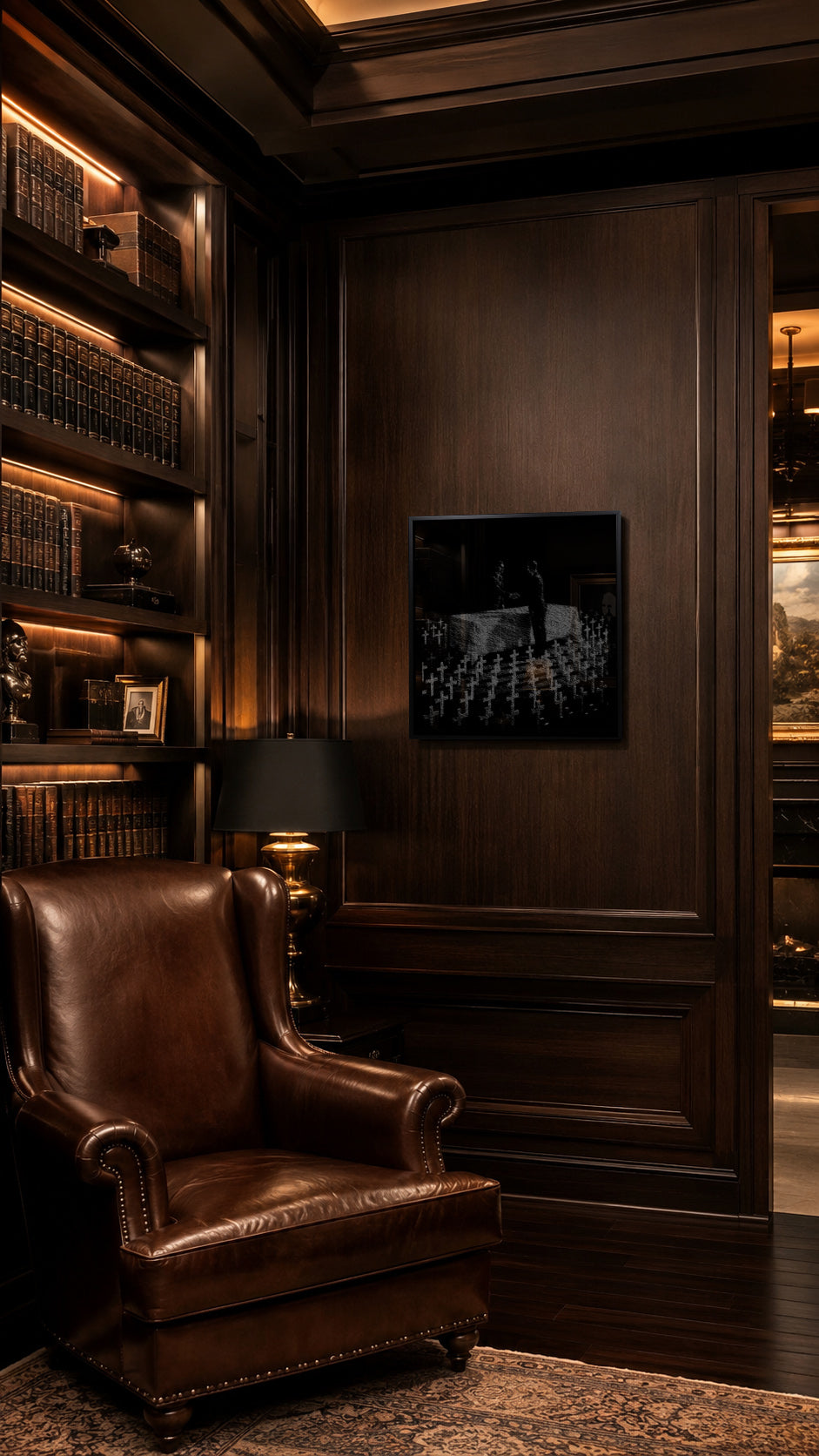
Two men meet across a table, suits pressed, hands clasped in the oldest gesture of agreement there is. Nothing about the handshake looks rushed. It is the kind of grip that closes a deal, signs a treaty, settles a border, and behind it there is no blood, no shouting, only the quiet efficiency of men who have done this before.
The white cloth that covers the table does not stop at the table's edge. It falls, and keeps falling, until it is no longer a cloth at all but a field, row after row of crosses stretching out beneath the two men and past the frame. The table, it turns out, was never separate from the ground it stands on.
In this work from the No Man's Land series within Art with Scratch, that field is not painted or printed onto the acrylic glass. It is formed through controlled surface damage, a field of fine scratches gathered into the white weight of the cloth and the pale ranks of crosses, while the two men keep their shape as dark, untouched silhouettes against the black. What glows is the ground. What stays in shadow are the men standing on it.
The image is always present, in daylight as much as under a single focused light. Light does not create the image. It sharpens it. Under direct light the scratched surface catches and the contrast deepens, the crosses gaining edge and weight, the cloth taking on a cold shine, and from another angle the same work settles back into quiet without ever losing the image.
The handshake is the whole transaction. Whatever was decided across that table, a border, a resource, a ceasefire, a surrender, it was decided above a field that answers to a different accounting. The men do not look down. They rarely do.
A Handshake Over the Fallen belongs to No Man's Land, a series within Art with Scratch by Tijs Dragtsma in which imagery is constructed through controlled surface damage rather than pigment or print, and in which that same damage becomes a way of showing how the men who decide at a table are never the ones who paid to set it.
A visual language where damage is not destruction, but structure. The cloth was always a shroud. It only needed the light to admit it.
"They shook hands. The ground did not."
More about the artist, process and materials can be found on the About page.
Questions about this work, availability or shipping can be sent through the contact page.