A Cathedral on Trembling Legs
A Cathedral on Trembling Legs
Coming to auction
This work will be included in a Catawiki auction within the next 10 days. Join the collectors list below to follow our auctions.
Occasional e-mails only. Unsubscribe anytime. Privacy policy.
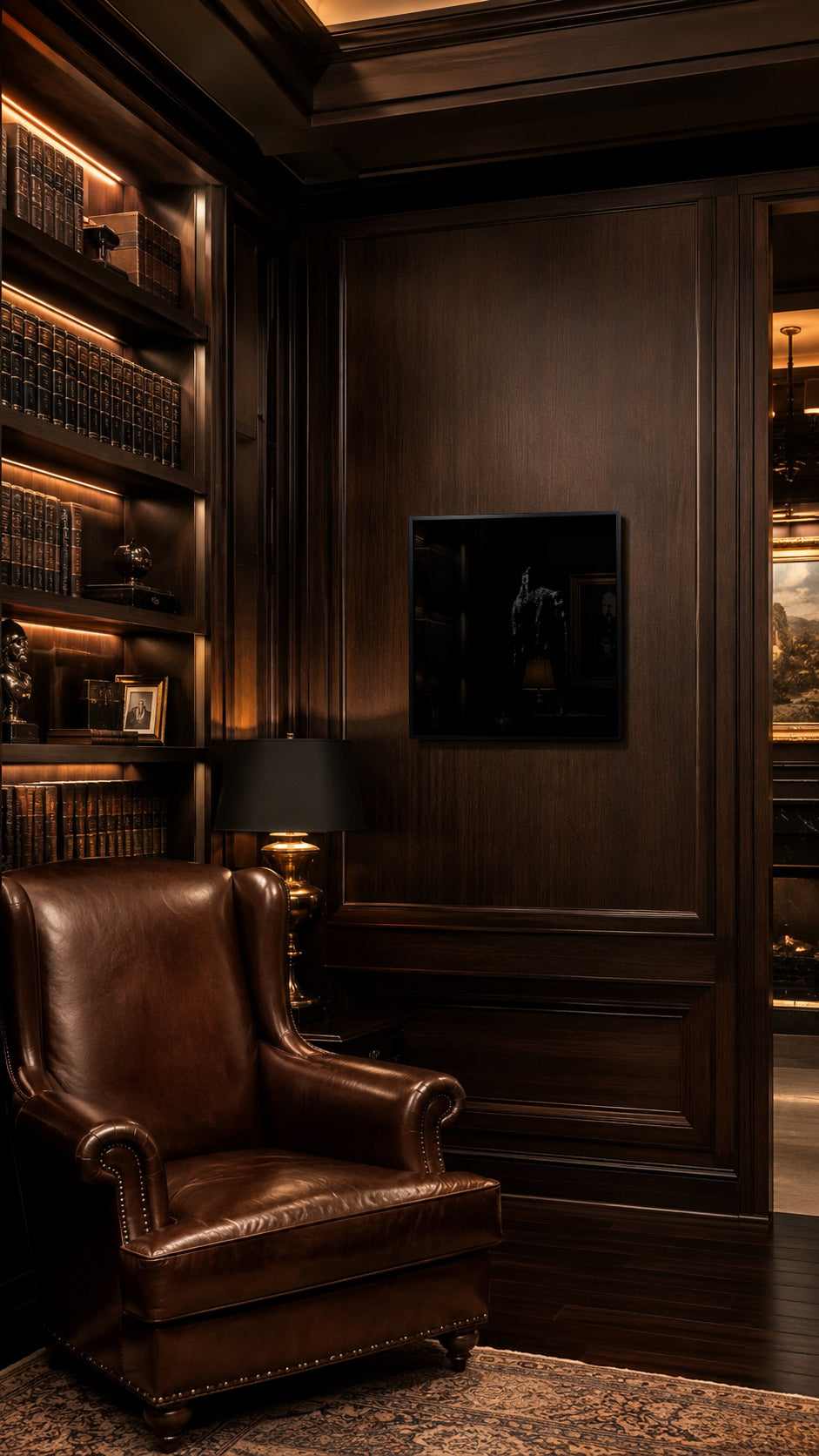
A Cathedral on Trembling Legs opens in near total darkness, and out of that darkness a single field of controlled scratches lifts a bell tower into light. The stonework glows first, sharp and articulate, while the creature beneath it, an elephant standing on legs too thin for what it carries, is barely there at all, a few lines holding its head and trunk out of the black.
No paint. No print. No ink. The image is scratched into the surface of the acrylic glass, and it is present at every hour of the day. Light does not create it. It sharpens it: turned toward a lamp or a window, the tower gathers more depth, more shine, while the animal's body stays where it belongs, in shadow, in doubt.
There is a kind of vertigo built into the composition. A cathedral is meant to stand on ground, on centuries of ground, not on the trembling legs of a living thing. Here the monument has been given a body, and the body cannot quite bear it. What looks, from a distance, like a solemn processional figure becomes, up close, an argument about weight, about what history asks its carriers to hold, and how thin the legs under any institution can turn out to be.
The elephant's face, patient and softly lit, is the only part of the animal allowed real clarity. Everything else, the legs, the trunk's long fall toward the ground, the ribs under the tower's foundation, is suggestion more than description. That is the discipline of this series, an image made by removing material rather than adding it, so that what remains feels less drawn than uncovered, as though the light had been waiting under the surface all along.
A Cathedral on Trembling Legs continues the Art with Scratch series by Tijs Dragtsma, in which imagery is constructed through controlled surface damage rather than pigment or print. Seen across a room, it reads as a solitary silhouette carrying a tower into the dark. Seen close, it dissolves into a field of individual marks, each one part of the same held breath.
This work is unique.
"Even monuments learn to walk on borrowed legs."
More about the artist, process and materials can be found on the About page.
Questions about this work, availability or shipping can be sent through the contact page.